
Okhrim Sudomora’s Children's Book and Anti-Soviet postcards

Okhrim Sudomora’s Children's Book and Anti-Soviet Postcards
Originally published by Emil Allakhverdov in ROSSICA Magazine, Issue No. 168, Spring 2017
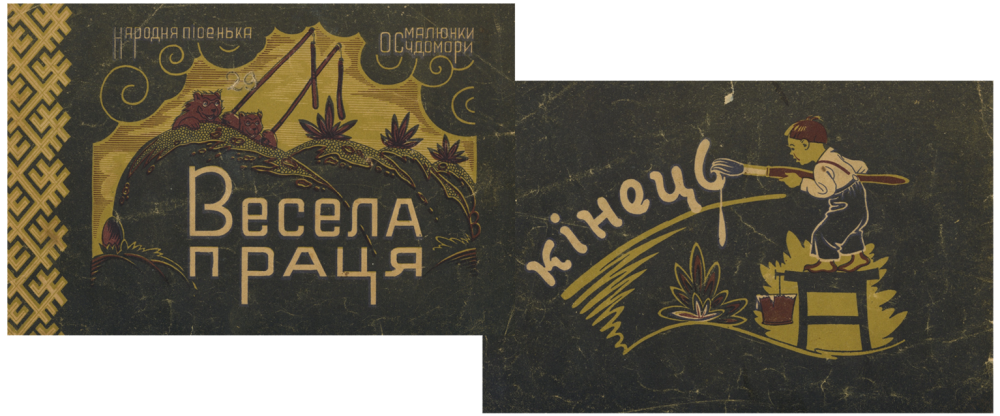
Figure 1
A few years ago, I came across an intriguing set of seven Ukrainian-language postcards titled Fun Work: A Folk Song in a New Way. At first glance, the cheerful illustrations appeared to be intended for children, but a closer examination revealed them to be powerful anti-Soviet and anti-Nazi political cartoons. Judging by the imagery, these postcards were likely produced shortly after Nazi Germany's defeat, reflecting the hopes of Ukrainian nationalists for the collapse of the Soviet regime as well. However, neither the image side nor the address side of the postcards contained any information about the publisher, leaving their origin shrouded in mystery.
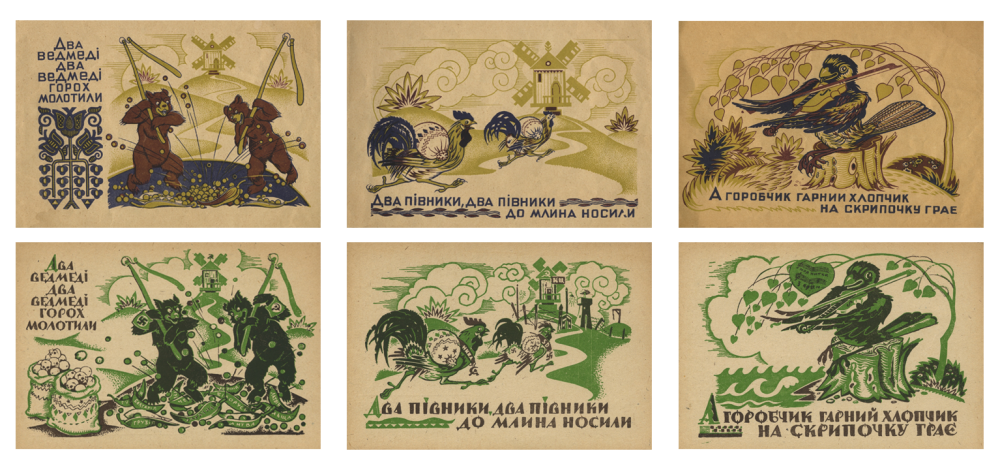
Figures 2, 3, 4
For years, the origins of these postcards puzzled me. Other postcard collectors familiar with the period were similarly in the dark regarding the artist, publisher, and place and date of their printing. Determined to uncover the truth, I began my search for answers. A few months ago, I acquired a unique collection of over 1,000 Ukrainian books, the majority of which were immigrant publications printed in Europe and the United States between 1918 and 1970. These works, mostly children’s books, included short-run publications, brochures, and booklets. While cataloging and researching the collection, I came across a small book that seemed oddly familiar. I couldn’t immediately place why, but as I flipped through the pages, I realized the illustrations reminded me of the postcards I had been investigating. When I compared the book’s illustrations to the postcards, I discovered that they were nearly identical, with only a few significant differences.
The book, titled Fun Work: A Folk Song, measures 13x19 cm (Figure 1) and was published by the Ukrainian Publishing House in Kraków and Lviv in 1944. The illustrations were created by Okhrim (Efrem) Ivanovich Sudomora, a well-known Ukrainian children’s book and magazine illustrator. The images bring to life the lyrics of a children’s song: “Two bears, two bears, threshed the peas; two roosters, two roosters took it to the mill; and the sparrow, a fine fellow, played the fiddle; the female sparrow, a pretty bird, swept the cottage; but the crows, good wives, went dancing; in flies the hook, the cane strikes and urges them on.”
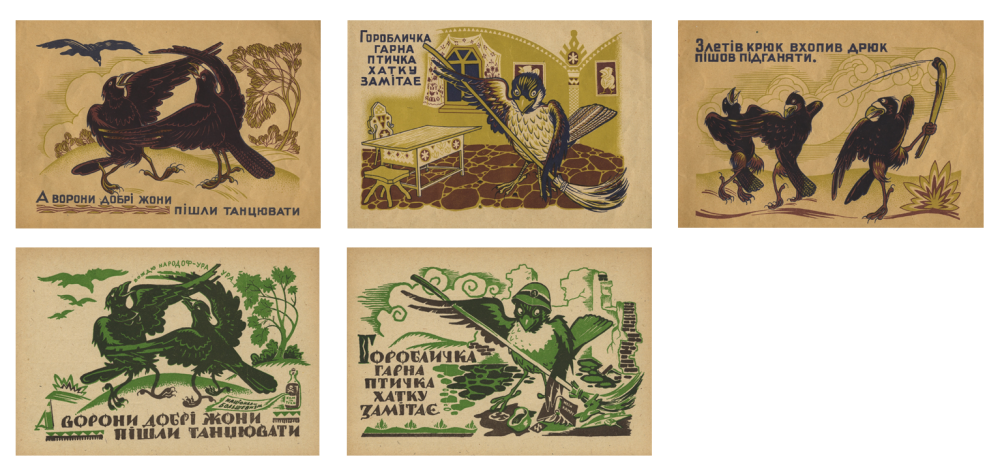
Figures 5, 6, 7
Out of the six illustrations in the book, five were adapted for the postcard series (Figures 2-6). Based on the book’s title, Fun Work: A Folk Song, and its publication year, 1944, it is reasonable to assume that the postcards in the series Fun Work: A Folk Song in a New Way were created by Sudomora during or shortly after 1944. The artist transformed his benign children’s illustrations into powerful anti-Soviet and anti-Nazi propaganda by altering key elements, such as symbols, slogans, and text, to reflect the regimes of the Soviet Union and Nazi Germany. The cheerful color palette of raw umber and olive buff was replaced with a somber scheme of military green, dark brown, and black.
If Sudomora indeed created the postcards, it was a bold and dangerous move that carried the risk of severe consequences under Stalinist rule. Alternatively, it is possible that another artist adapted Sudomora’s illustrations into propaganda, perhaps someone in a Ukrainian Displaced Persons (DP) camp in post-war Germany. The printing quality and type of paper used for the postcards suggest they may have been produced in Germany. However, the stylistic similarities strongly point to Sudomora as the creator, even if the actual printing occurred elsewhere, possibly with his involvement.

Figures 8, 9
Okhrim Sudomora was a distinguished artist and professional illustrator, often called the “Ukrainian Aubrey Beardsley.” Born in Boryspil (then Borispol) in 1889, he studied iconography in the workshop of the Kyiv Pechersk Lavra from 1904 to 1907 before continuing his education at the Kyiv Art School. By 1913, Sudomora was illustrating children’s books for publishers in Kyiv, Vienna, and Prague. In 1914, he designed the magazine Siyanie (Glow) and worked on numerous children’s fairy tale books, including The War of the Mushrooms and Bugs, which was published in 1919 during the Russian Civil War.
From 1924, Sudomora collaborated with publishers in Kharkiv and Kyiv, contributing to Soviet publications such as Soviet Village, Soviet School, and the youth organization’s magazine Pioneer. In 1943, he moved to Lviv, which was then under German control. The city had a strong nationalist Ukrainian movement and was nearing the end of its mass extermination of the Jewish population. While in Lviv, Sudomora worked for the Ukrainian Publishing House and illustrated the children’s magazine Small Friends. When the Soviet army recaptured Lviv in 1945, Sudomora relocated to Kharkiv, where he worked for various publishing houses until his arrest in 1949 on charges of anti-Soviet activities. He was sentenced to 25 years in prison, reportedly for creating a caricature of Stalin with blood-stained hands. Some accounts claim Sudomora was granted amnesty in 1955, while others suggest he was killed in prison by the NKVD. According to his grandson, however, Sudomora lived in Kyiv after 1955 with his wife, son Yuri, and daughter Catherine, and passed away in 1965 (though some sources state 1968).

Figure 10
Whether the postcard series played a role in Sudomora’s arrest and incarceration remains uncertain. However, their striking transformation from children’s illustrations into propaganda reveals the ingenuity and courage of the artist, even under oppressive regimes. These postcards, with their layered symbolism and mystery, remain a fascinating subject for collectors and scholars. Their discovery has deepened our understanding of Sudomora’s work, challenging us to examine the details that make these pieces so compelling.
Figure 1. Front and back covers of the children’s book
Figure 2. The German and Russian bears identified by their swastika and hammer-and-sickle armbands are “threshing” victims from nations like Ukraine, Bulgaria, Lithuania, and others.
Figure 3. The Nazi and Communist secret police “roosters” are taking those bags of victims to be ground in the millstones of the concentration camp.
Figure 4. Whatseems to be a uselessly uninvolved “sparrow” in fiddling the “It’s not my problem, I know nothing” song.
Figure 5. The crows are cawing their hurrahs to Stalin, the “Leader of the Peoples.” They’ve been prescribed the poison of Comintern through National Bolshevism.
Figure 6. The anti-Nazi “sparrow” is sweeping away “Mein Kampf,” the Nazi flag, and other Third Reich symbols.
Figure 7. This last illustration in the children’s story was not used for the postcard series. Instead, two additional cartoons were made for the postcard set, as shown below in illustrations 7 and 8. One of them, Figure 8, re-worded the last line of the children’s song but kept its meaning similar.
Figure 8. This is the “cover” postcard in the “Happy Work” set. It shows two tattered bears, symbolizing Russia and Germany, lugging Bolshevism, Nazism, atheism, class warfare, racism, and other ills to the trash heap of history.
Figure 9. The caption on the final postcard of this propaganda set says, “People will stand up, look around, and will begin scattering them!” It shows a determined, heroic Ukrainian who has broken his concentration camp chains and is going after the fleeing Soviet bear and his sidekick the secret police rooster. The two are heading back to their fortress of “dictatorship” and “jail of nations,” while the German bear is already lying flat on his back.
Figure 10. By superposing an illustration from the book and its politicized postcard version we see how closely they match and where they differ.